
Ian Chiswell
Queen Mary, University of London
Mile End Road
London E1 4NS
Ian Chiswell |
| |
| Address : | School of Mathematical Sciences Queen Mary, University of London Mile End Road London E1 4NS | |
| Office : | Mathematics 502 | |
| Telephone : | 020 7882 8518 (from U.K.) 44 20 7882 8518 (from elsewhere) | |
| School Fax : | 020 7882 7684 (from U.K.) 44 20 7882 7684 (from elsewhere) | |
| Email Address : | I.M.Chiswell @ qmul.ac.uk | |
I am an Emeritus Professor of Pure Mathematics in the School of Mathematical Sciences at Queen Mary, University of London.
The general area of my research is geometric group theory, formerly known as combinatorial group theory, that is, the study of groups given by generators and relations. As the name suggests, it has long-standing connections with geometry and topology. All of my early work had connections with the Bass-Serre structure theory for group actions on trees. This includes work on length functions in the sense of Lyndon, which are connected with Λ-trees, where Λ is an ordered abelian group. Since then, the majority of my work has been on generalised trees, mainly on isometric actions of groups on Λ-trees. An ordinary tree defines an integer-valued metric on its set of vertices, just by taking the shortest path between two vertices, and defining their distance apart to be the number of edges in the path. The idea of a Λ-tree is obtained by considering Λ-valued metrics having certain properties in common with this metric. The special case of R-trees has proved to be useful in topology, and for certain non-archimedean ordered abelian groups Λ, there are connections with model theory.
Other parts of my work are related to homology and cohomology of groups. This includes Euler characteristics of discrete groups and asphericity of group presentations.
A recent theme of my work on Λ-trees has been on certain generalisations of free groups, involving words indexed by ordered abelian groups instead of integers. However my most recent work has been on ordered groups. The theory of such groups also has connections with topology, especially manifold theory and knot theory.
 |
 |
 |
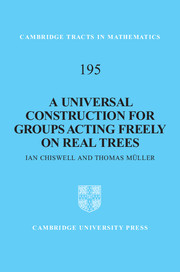 |
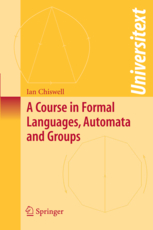
| Introduction to Λ-trees* | Mathematical Logic* | A Course in Formal Languages, Automata and Groups* | A Universal Construction for Groups Acting Freely on Real Trees |
| (with Wilfrid Hodges) | (with Thomas Müller) | ||
| World Scientific, Singapore 2001 | Oxford University Press 2007 | Springer, London 2009 | Cambridge University Press 2012 See also here |
I am currently doing no teaching